How to measure square feet
How to measure square feet for any room: length × width, L-shapes, triangles and circles, sq ft to m², flooring waste and wall area for paint.
October 9, 2026
Square footage calculator
- Total
- 198 sq ft
- m²
- 18.39 m²
- With 10% extra for flooring
- 217.8 sq ft
To measure square feet, measure the length and width of the space in feet and multiply them. A room 12 ft long and 10 ft wide is 12 × 10 = 120 square feet. For rooms that are not a simple rectangle, split the floor into rectangles, work out each one, and add them up. The calculator above does the adding for you and shows the total in square feet and square meters.
What you need
- A tape measure, 25 ft is the easiest length for rooms. If the markings give you trouble, see how to read a tape measure.
- Paper and a pencil to sketch the floor plan and write each measurement on it.
- A helper for long runs, or a hook on the tape that you can catch on a baseboard.
Measure wall to wall at floor level, along the baseboard. Take the length at two points if the walls look out of line and use the larger figure when you are buying material.
Rectangles: length × width
Most rooms are rectangles, and the formula is simple:
Area (sq ft) = length (ft) × width (ft)
The only step that trips people up is the inches. A tape gives you readings like 12 ft 6 in, and you cannot multiply feet and inches directly. Convert the inches to a decimal of a foot first by dividing by 12.
| Inches | Decimal feet |
|---|---|
| 1 in | 0.08 ft |
| 3 in | 0.25 ft |
| 4 in | 0.33 ft |
| 6 in | 0.5 ft |
| 8 in | 0.67 ft |
| 9 in | 0.75 ft |
So 12 ft 6 in becomes 12.5 ft and 10 ft 3 in becomes 10.25 ft. Then 12.5 × 10.25 = 128.1 sq ft.
The other route is to measure everything in inches, multiply, and divide by 144, because one square foot is 12 in × 12 in = 144 square inches. A tile 18 in × 14 in is 252 sq in, and 252 ÷ 144 = 1.75 sq ft. This works well for small items like rugs, tiles and countertop pieces.
L-shaped and irregular rooms
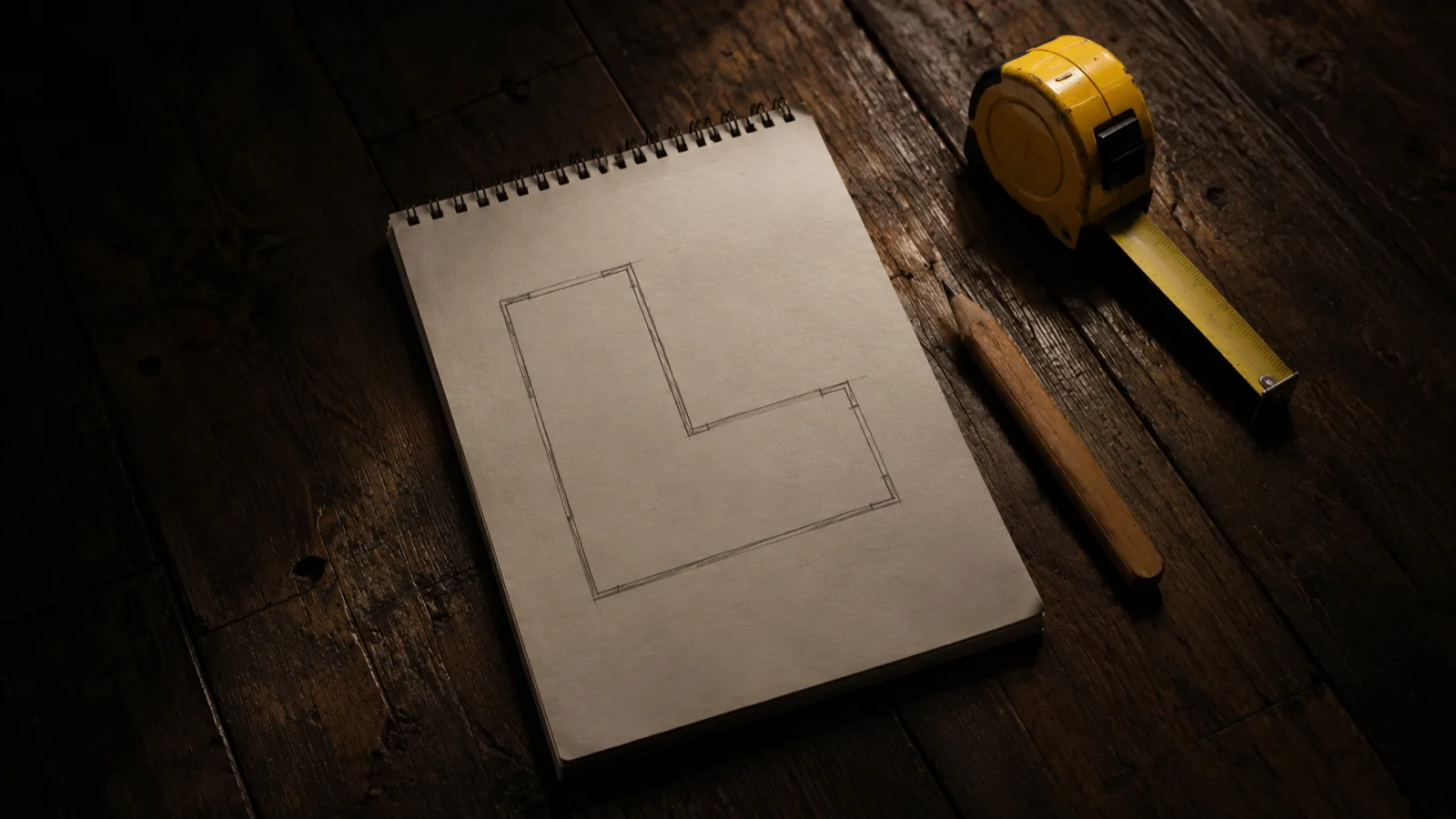
Draw the room from above and divide it into rectangles that do not overlap. Measure each rectangle, find its area, and add the areas together.
Take an L-shaped living room. The main part is 14 ft × 12 ft and the extension is 8 ft × 6 ft:
- Main section: 14 × 12 = 168 sq ft
- Extension: 8 × 6 = 48 sq ft
- Total: 168 + 48 = 216 sq ft
You can also measure the full bounding rectangle and subtract the missing corner. Both methods give the same answer, so use whichever needs fewer measurements. For closets, bay windows and alcoves, treat each one as its own small rectangle and add it in.
Triangles and circles
Some spaces have an angled wall or a rounded section.
- Triangle: area = ½ × base × height. The height is measured square to the base, not along the sloping side. A triangle with a 10 ft base and 6 ft height is ½ × 10 × 6 = 30 sq ft.
- Circle: area = π × r², where r is the radius (half the diameter) and π ≈ 3.1416. A round patio 6 ft across has a radius of 3 ft, so 3.1416 × 3 × 3 = 28.3 sq ft.
- Half circle: work out the full circle and divide by 2. A bay with a 3 ft diameter half-round is 7.07 ÷ 2 = 3.5 sq ft.
For any odd shape, break it into rectangles, triangles and circle sections, then add the pieces.
Worked example
Here is a full floor measured piece by piece. The figures are what you would enter in the calculator above.
| Area | Measurement | Square feet |
|---|---|---|
| Living room (main) | 14 ft × 12 ft | 168.0 |
| Living room (L extension) | 8 ft × 6 ft | 48.0 |
| Hallway | 12 ft 6 in × 3 ft 6 in | 43.8 |
| Bedroom | 12 ft 6 in × 10 ft 3 in | 128.1 |
| Closet | 6 ft × 2 ft | 12.0 |
| Total | 399.9 | |
| Total + 10% waste | 439.9 |
That floor is about 400 sq ft, or 37.2 m². If you are ordering flooring, round up to the next full box after adding waste.
Converting square feet and square meters
Flooring sold in metric countries and many product spec sheets use square meters.
- 1 m² = 10.7639 sq ft
- 1 sq ft = 0.0929 m²
- 1 sq yd = 9 sq ft (carpet is still sold by the square yard in some US stores)
| Square feet | Square meters |
|---|---|
| 100 | 9.29 |
| 150 | 13.94 |
| 200 | 18.58 |
| 300 | 27.87 |
| 500 | 46.45 |
| 1,000 | 92.90 |
To go from square feet to square meters, multiply by 0.0929. To go the other way, multiply by 10.7639. Do not convert the area with the length factor of 3.28; that number is for feet to meters in a straight line, and squaring changes it.
Flooring waste allowance
Always buy more material than the measured area. Pieces get cut at walls, doorways and around obstacles, and some boards or tiles arrive damaged.
A common allowance is 5 to 10 percent for a straight layout in a simple room. Diagonal and herringbone layouts produce more offcuts, and installers often add 10 to 15 percent or more for those. Large-format tiles, patterned carpet and rooms with many corners also push the figure up. The right number varies with the product and the installer, so check the manufacturer’s instructions or ask your flooring supplier. The calculator above shows the total with 10 percent added as a starting point.
Keep a spare box or two after the job. Matching the same batch years later for a repair is hard.
Wall area for paint
For walls, measure the room’s perimeter and multiply by the ceiling height:
Wall area = (sum of all wall lengths) × ceiling height
A 12 ft × 14 ft room has a perimeter of 12 + 14 + 12 + 14 = 52 ft. With 8 ft ceilings that is 52 × 8 = 416 sq ft of wall.
Then subtract the openings you will not paint. The most accurate method is to measure each door and window and multiply width by height. For a rough estimate, many paint guides subtract about 20 sq ft for a standard door and about 15 sq ft for an average window. Sizes vary a lot, so measure any large windows or sliding doors. The example room with one door and two windows comes to 416 − 20 − 30 = 366 sq ft.
Check the coverage printed on the paint can, multiply by the number of coats, and round up to whole cans.
Measuring area with your phone
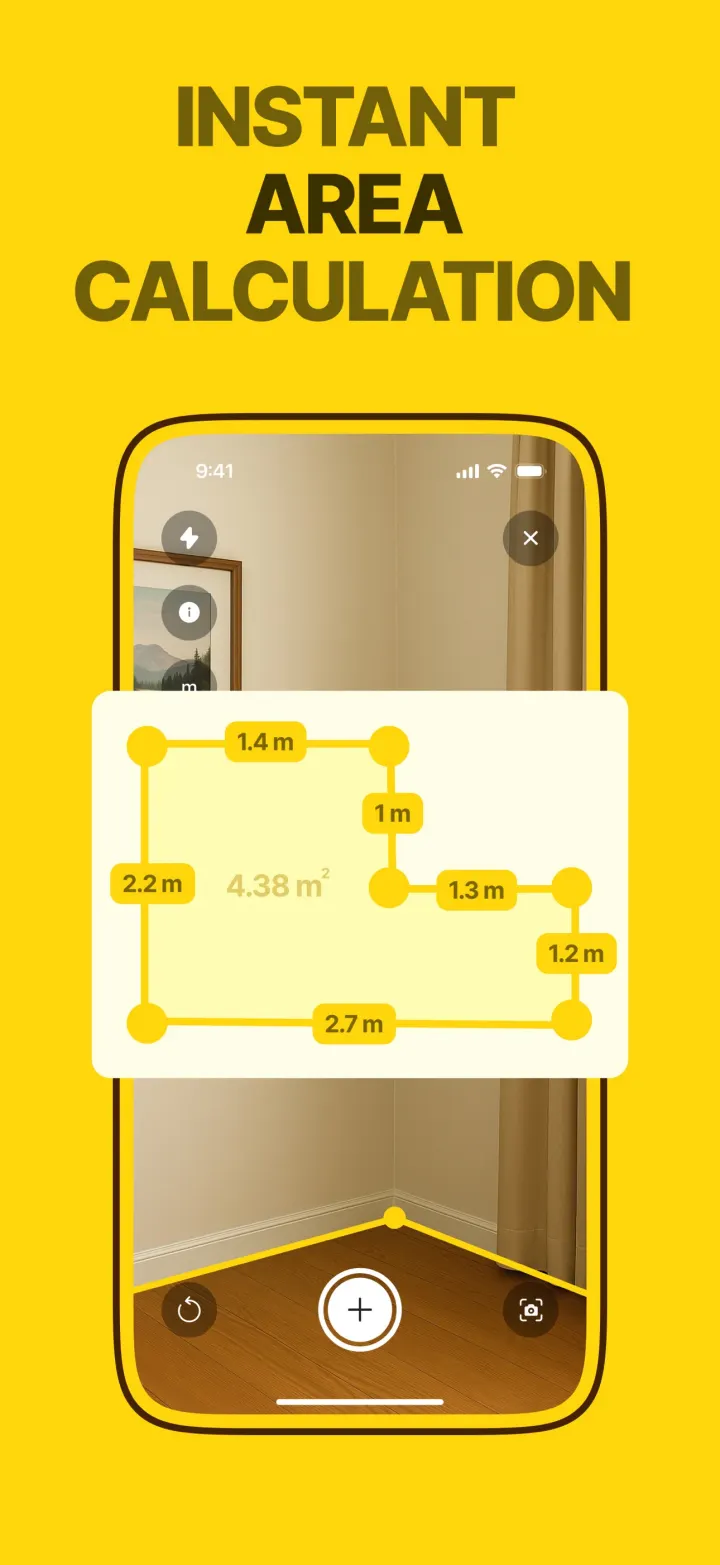
If you want a quick figure before you get the tape out, the Area tool in Measuring Tape & AR Ruler App lets you tap each corner of the floor with your iPhone camera. It closes the shape, labels each side and shows the total area, and you can copy or share the report. See the room measurement app page for how it works. AR readings are close but not exact, and the error grows with distance, so confirm with a tape before you order materials or cut anything.
For windows in the same room, see how to measure a window.
Sources
- How to Measure Square Footage of a Room, Lowe’s: area is length × width, and L-shaped or odd-shaped rooms are measured in sections and added together.
- NIST Guide to the SI, Appendix B.8: Factors for Units Listed Alphabetically, NIST: 1 square foot equals exactly 0.09290304 square meters.
- How to Calculate the Correct Footage When Purchasing Hardwood Flooring, Mullican Flooring: add about 5 percent for waste on a standard hardwood install and 10 to 15 percent on a diagonal.
- How Much Exterior Paint Do I Need?, Behr: wall area is the perimeter times the wall height, less about 15 sq ft for an average window and 20 sq ft for an average door.