How to measure ring size at home
How to measure ring size at home with a ring you own or a paper strip, plus a US ring size chart with inside diameter and circumference in mm and inches.
October 23, 2026
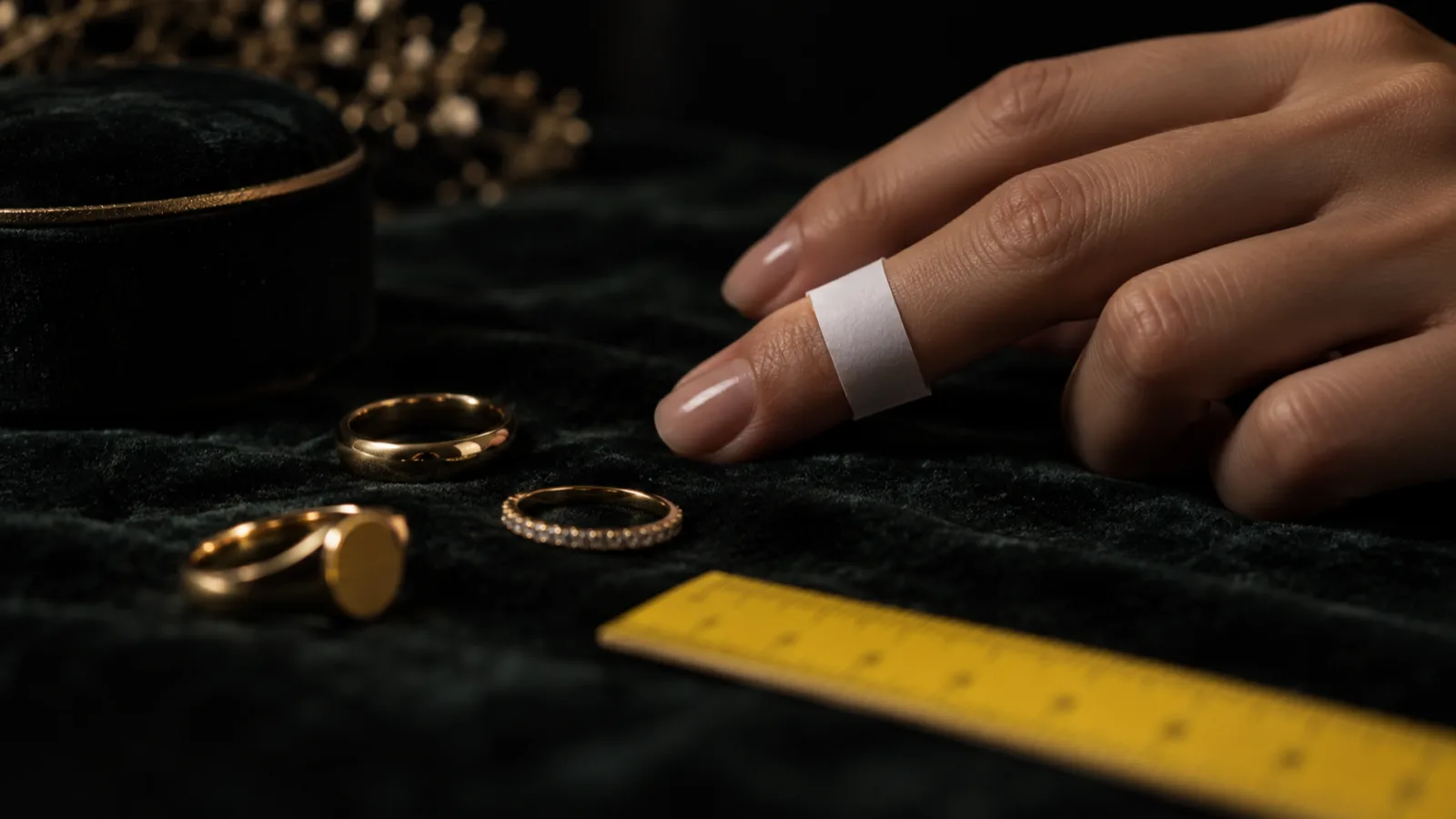
The most accurate way to measure ring size at home is to measure the inside diameter of a ring that already fits, in millimeters, and look it up in a size chart. A ring that is 17.3 mm across the inside is a US size 7. Without a ring, wrap a thin strip of paper around the base of your finger, mark where it overlaps, measure the length in millimeters and match that circumference to the chart. A 54.4 mm strip is also a size 7.
How US ring sizes work
US and Canadian ring sizes are a number scale based on the inside of the ring. Each whole size adds about 0.81 mm (0.032 in) to the inside diameter, which is about 2.55 mm around the inside. Sizes come in half and quarter steps. A half size is only 0.4 mm of diameter, so small reading errors matter.
Two conversions cover everything on this page:
- From circumference: US size ≈ (circumference in mm − 36.5) ÷ 2.55
- From diameter: US size ≈ (diameter in mm − 11.63) ÷ 0.813
For example, a 55 mm strip gives (55 − 36.5) ÷ 2.55 = 7.25, a size 7¼. Measure in millimeters if you can. An inch ruler marked in sixteenths is too coarse for ring sizes.
Method 1: measure a ring that already fits
- Pick the right ring. Use one that fits the finger you are sizing, on the same hand. Fingers on your left and right hands can be different sizes. A thin, plain band works best.
- Lay it on a ruler. Put the ring flat on a ruler with a millimeter scale. If you need a refresher on the scale, see how to read a ruler.
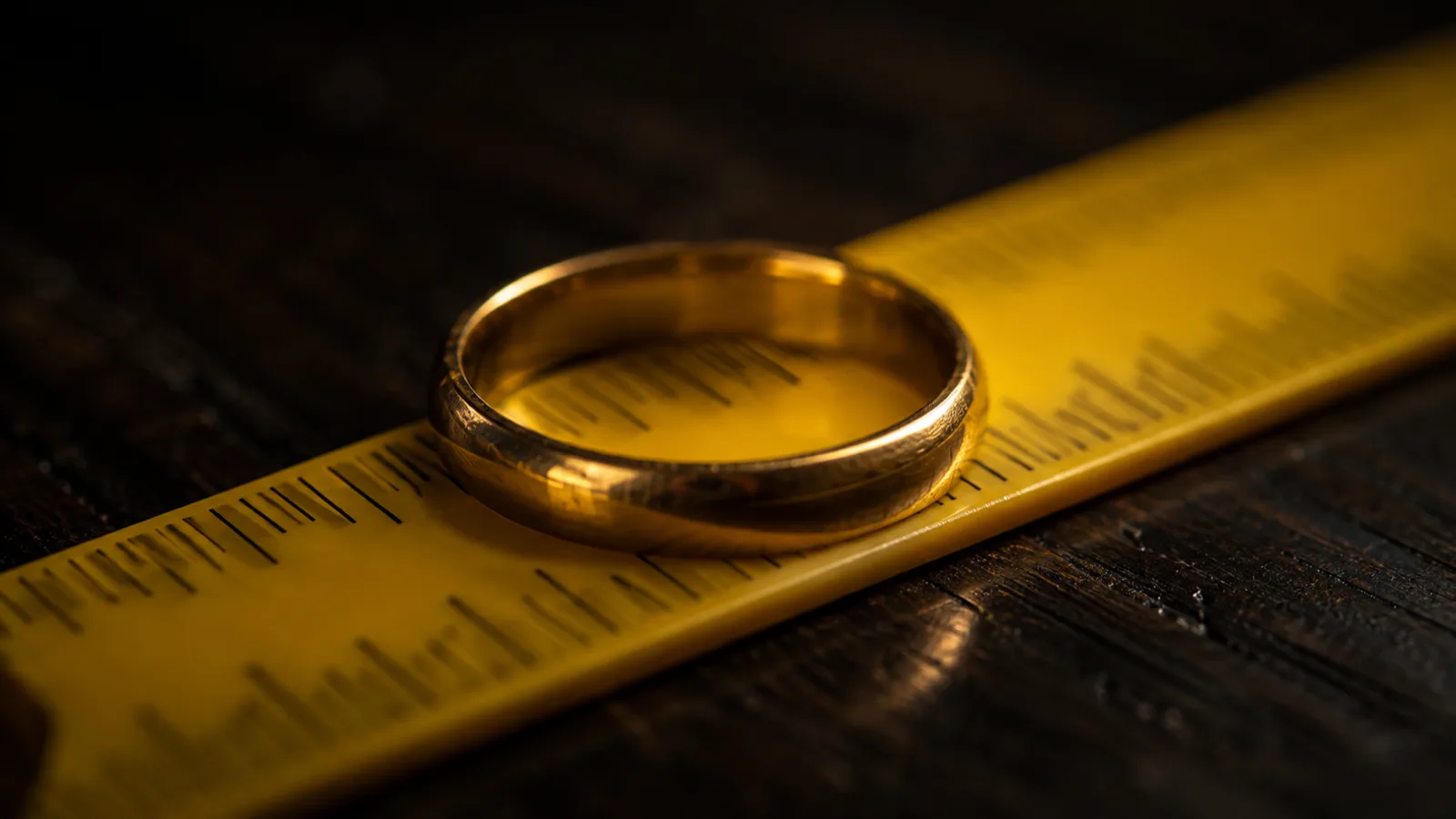
- Measure the inside. Line up the zero mark with one inside edge and read where the opposite inside edge falls. Measure straight across the center, at the widest point, which is the ring’s inside diameter (how to measure diameter covers inside and outside readings). Leave out the metal of the band itself.
- Turn and repeat. Rotate the ring a quarter turn and measure again. Rings can be slightly out of round. Average the two readings.
- Look it up. Find the diameter in the chart below.
A ruler gets you within about half a size. Comfort-fit bands have a rounded inside, so the opening at the edges looks larger than the fit. For those, or for a ring that matters, a jeweler’s sizer is more reliable.
Method 2: the paper strip or string method
Paper works better than string, because string can stretch and twist. If you only have string, use a thin, non-stretch one such as dental floss.
- Cut a strip. Make it about 1/4 in (6 mm) wide and 4 in (10 cm) long.
- Wrap the finger. Wrap it around the base of the finger where the ring will sit. It should be snug without squeezing the skin.
- Mark the overlap. Use a fine pen to mark where the end of the strip meets the rest of it.
- Check the knuckle. Slide the loop off. If it will not pass over your knuckle, the size is too small for you to wear. See the knuckle tip below.
- Measure the length. Lay the strip flat and measure from the end to the mark in millimeters.
- Look it up. Find that circumference in the chart, or use the formula above.
Measure three times, ideally on different days. If the readings differ, go with the one that comes up most often.
Wrapping, marking and measuring flat works for any circumference when you have no soft tape. How to measure hat size uses the same idea with string around the head.
US ring size chart
| US size | Inside diameter (mm) | Inside circumference (mm) | Inside circumference (in) |
|---|---|---|---|
| 4 | 14.9 | 46.8 | 1.84 |
| 4½ | 15.3 | 48.0 | 1.89 |
| 5 | 15.7 | 49.3 | 1.94 |
| 5½ | 16.1 | 50.6 | 1.99 |
| 6 | 16.5 | 51.9 | 2.04 |
| 6½ | 16.9 | 53.1 | 2.09 |
| 7 | 17.3 | 54.4 | 2.14 |
| 7½ | 17.7 | 55.7 | 2.19 |
| 8 | 18.1 | 57.0 | 2.24 |
| 8½ | 18.5 | 58.2 | 2.29 |
| 9 | 18.9 | 59.5 | 2.34 |
| 9½ | 19.4 | 60.8 | 2.39 |
| 10 | 19.8 | 62.1 | 2.44 |
| 10½ | 20.2 | 63.3 | 2.49 |
| 11 | 20.6 | 64.6 | 2.54 |
| 11½ | 21.0 | 65.9 | 2.59 |
| 12 | 21.4 | 67.2 | 2.64 |
| 12½ | 21.8 | 68.5 | 2.70 |
| 13 | 22.2 | 69.7 | 2.75 |
The chart follows the standard US scale, where a size 0 has an inside diameter of 11.63 mm and each size adds 0.8128 mm. Jewelers’ charts can differ by a few tenths of a millimeter because of rounding. Solvar, for example, lists a size 7 as 17.3 mm across and 54.5 mm around. Some retailers use their own sizing, so when you buy a specific ring, check the seller’s chart too.
Tips for an accurate ring size
- Measure warm, not cold. Fingers shrink in the cold and swell in heat. Glamira says the difference can be at least half a size either way. Measure at a normal room temperature.
- Measure later in the day. Fingers are often slimmer in the morning. Evening gives a reading closer to how the ring will feel most of the day.
- Avoid swollen moments. Skip measuring right after exercise, a hot shower, or a salty meal.
- Account for the knuckle. If your knuckle is wider than the base of the finger, measure both and choose a size between the two. The ring has to slide over the knuckle and still stay put at the base.
- Size up for wide bands. A band 6 mm wide or more feels tighter than a thin one. Glamira suggests going one size up for those.
- Pick the larger size when in doubt. A ring that is slightly loose is still wearable. A ring that will not pass your knuckle is not.
- See a jeweler for important rings. For an engagement or wedding ring, a jeweler’s metal sizers give the most reliable answer.
Common mistakes
- Measuring the outside of the ring. The band’s thickness adds several sizes. Always measure the inside edge.
- Pulling the strip too tight. A strip that dents the skin gives a size that is too small.
- Using a ring from another finger. Even neighboring fingers are rarely the same size.
- Rounding to the nearest eighth of an inch. An eighth of an inch is about 3.2 mm, almost four full sizes of diameter. Work in millimeters.
- Using a stretchy material. Yarn, elastic or a cloth tape that has stretched over time all read short.
If your ruler is missing or worn, how to measure without a tape measure lists everyday objects with known sizes you can check against.
Sources
- Ring size, Wikipedia: US sizes step by about 0.81 mm of inside diameter (2.55 mm of circumference), size 0 is 11.63 mm across, with a conversion table for each size.
- Ring Size Chart, Solvar: jeweler’s US chart with inside diameter and circumference in mm; paper strip method; a local jeweler gives the most accurate sizing.
- Ring Size Guide, Glamira: measure in the evening at average temperature; cold or hot hands shift the size by about half a size; measure knuckle and base and choose between; go a size up for bands 6 mm or wider.