How to measure your chest
How to measure chest size with a soft tape: where to put it, how tight to pull, chest vs bust, common mistakes and a men's shirt size chart in inches and cm.
November 10, 2026
To measure your chest, stand straight with your arms relaxed at your sides and wrap a soft tape measure around the fullest part of your chest, just under the armpits and across the shoulder blades. Keep the tape level all the way around and snug without pressing into the skin, then read it after a normal breath out. That number, in inches or centimeters, is the chest size that shirt and jacket size charts ask for.
What you need
- A soft tape measure. A sewing tape made of fiberglass or vinyl follows the body. A steel tape will not wrap around a torso properly.
- A helper or a mirror. The tape tends to drop at the back where you cannot see it. A second person makes this much easier.
- Thin clothing or none. Measure over bare skin or a thin, fitted t-shirt. A sweater or hoodie adds bulk that ends up in the number.
No soft tape at home? Wrap a piece of string or a phone charging cable around your chest, pinch the point where it meets, then lay it flat against a steel tape or ruler. The guide to measuring without a tape measure covers more substitutes, and how to read a ruler helps with the fractions.
How to measure your chest step by step
- Stand naturally. Feet together, shoulders relaxed, looking straight ahead. Do not puff out your chest or pull your shoulders back.
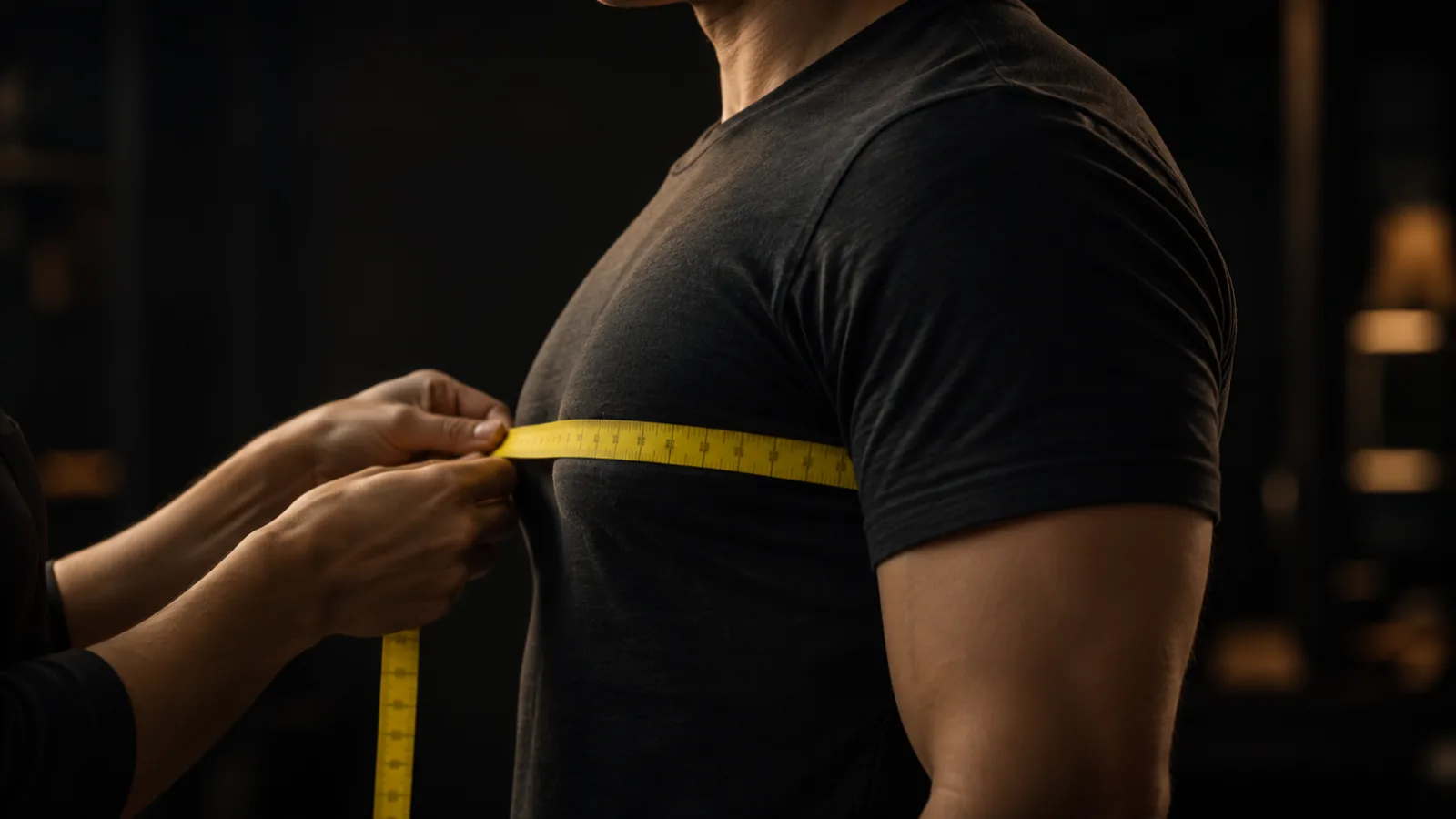
- Place the tape. Lift your arms a little, pass the tape around your back and bring it under both armpits. Lower your arms once it is in place.
- Find the fullest part. At the front the tape sits across the widest part of the chest, which for most men is roughly at nipple level. At the back it crosses the shoulder blades.
- Level it. Check in the mirror or have your helper check that the tape is horizontal all the way around, with no dip at the back.
- Set the tension. The tape should lie flat against the body. You should be able to slide one finger under it, and it should not dig in or leave a mark.
- Breathe out and read. Take a normal breath, let it out, and read where the zero end meets the scale. Round to the nearest half inch, since most size charts use whole and half inches.
- Measure again. Take the tape off and repeat. If the two readings differ, measure a third time and use the figure that comes up twice.
Chest vs bust
Men’s size charts use the word chest. Women’s charts usually say bust, and the two are measured slightly differently.
- Chest is taken high, under the armpits and across the shoulder blades, as described above.
- Bust is taken around the fullest point of the bust, which sits lower on the body. L.L.Bean’s women’s chart puts it simply as measuring around the chest at the fullest point of the bust. Measure over a non-padded bra so the number matches how clothes will sit.
- Underbust is the measurement directly under the bust, around the ribcage where a bra band sits. Bra size charts use it for the band size. It is a separate number from bust.
If a woman is using a unisex chart that only lists chest, the bust measurement is usually the right one to compare, because that is the widest point a top has to fit around.
Men’s shirt sizes by chest
Size charts for t-shirts, sweaters and casual shirts list body measurements in inches. Brands do not agree on where one size ends and the next begins, so treat this table as a guide and always check the chart for the brand you are buying.
| Size | L.L.Bean chest (in) | Nike chest (in) | L.L.Bean chest (cm) |
|---|---|---|---|
| S | 34–36 | 35–37.5 | 86–91 |
| M | 38–40 | 37.5–41 | 97–102 |
| L | 42–44 | 41–44 | 107–112 |
| XL | 46–48 | 44–48.5 | 117–122 |
| XXL | 50–52 | 48.5–53.5 | 127–132 |
A man with a 41 in (104 cm) chest falls between M and L at L.L.Bean but is right on the M and L boundary at Nike. Nike’s chart says to pick the smaller size for a tighter fit and the larger one for a looser fit, and to go with your chest size when your chest and waist point to different sizes.
To convert, multiply inches by 2.54 to get centimeters, or divide centimeters by 2.54 to get inches.
Dress shirts are sized differently. They use neck size and sleeve length, so a shirt labeled 16/34 has a 16 in neck and a 34 in sleeve. L.L.Bean’s chart lines up a 16 to 16.5 in neck with size L, but chest still decides how the shirt fits across the body.
US suit jackets and sport coats are labeled by chest size in inches with a length letter, so a 40R is cut for roughly a 40 in chest at regular length. Cuts vary, so try one on or check the brand’s chart. Tall sizes add length for taller builds; L.L.Bean’s tall range is for men 6 ft 1 in to 6 ft 3 in. If you are not sure of your height, stand against a wall and measure it, or use a height measurement app on your phone.
Body measurement vs garment measurement
The numbers in a size chart are body measurements. The shirt itself is always bigger than the chest it is made for, because clothes need room to move. A relaxed fit has more of that extra room than a slim fit.
That means a shirt you own will measure larger than your chest. To check a garment, lay it flat, button it, and measure straight across from armpit seam to armpit seam. Double that figure for the garment’s chest. Compare it with the same measurement from a shirt that fits you well, and you will know how much room you like.
Chest sets the size, but a shirt can still sit wrong across the top or run short in the arm. Check shoulder width and sleeve length the same way before you order.
Common mistakes
- The tape drops at the back. A slanted tape follows a longer path around the body and reads too large. This is the most common error when measuring alone.
- Pulling too tight. A tape that squeezes the skin gives a small reading and a shirt that feels tight across the chest.
- Measuring with arms raised. Lifting the arms tenses the back muscles and changes the reading. Place the tape, then lower your arms before you read it.
- Holding a deep breath. A full inhale expands the ribcage and inflates the reading. Read after a normal breath out.
- Measuring over thick clothing. Seams, pockets and knit fabric all add to the number.
- Mixing up chest, bust and underbust. Each one has its own place on a size chart, and using the wrong one can put you in the wrong size.
- Using a stretched tape. Old cloth tapes stretch over time. Check yours against a steel tape every so often. If the markings on a steel tape are unfamiliar, see how to read a tape measure.
Sources
- Men’s Size Chart, L.L.Bean Business: chest ranges S 34–36 in through XXL 50–52 in, neck sizes, the tall height range of 6 ft 1 in to 6 ft 3 in, and the instruction to measure just under the arms and across the shoulder blades with the tape firm and level.
- Men’s Tops Size Chart, Nike: chest ranges by size in inches, the instruction to measure around the fullest part of the chest with the tape horizontal, and advice for choosing between sizes.
- Women’s Size Chart, L.L.Bean Business: bust is measured around the chest at the fullest point of the bust.