How to measure wrist size
How to measure wrist size with a soft tape or a paper strip, where to wrap it, how snug to pull it, and how much to add for a watch strap or a bracelet.
November 24, 2026
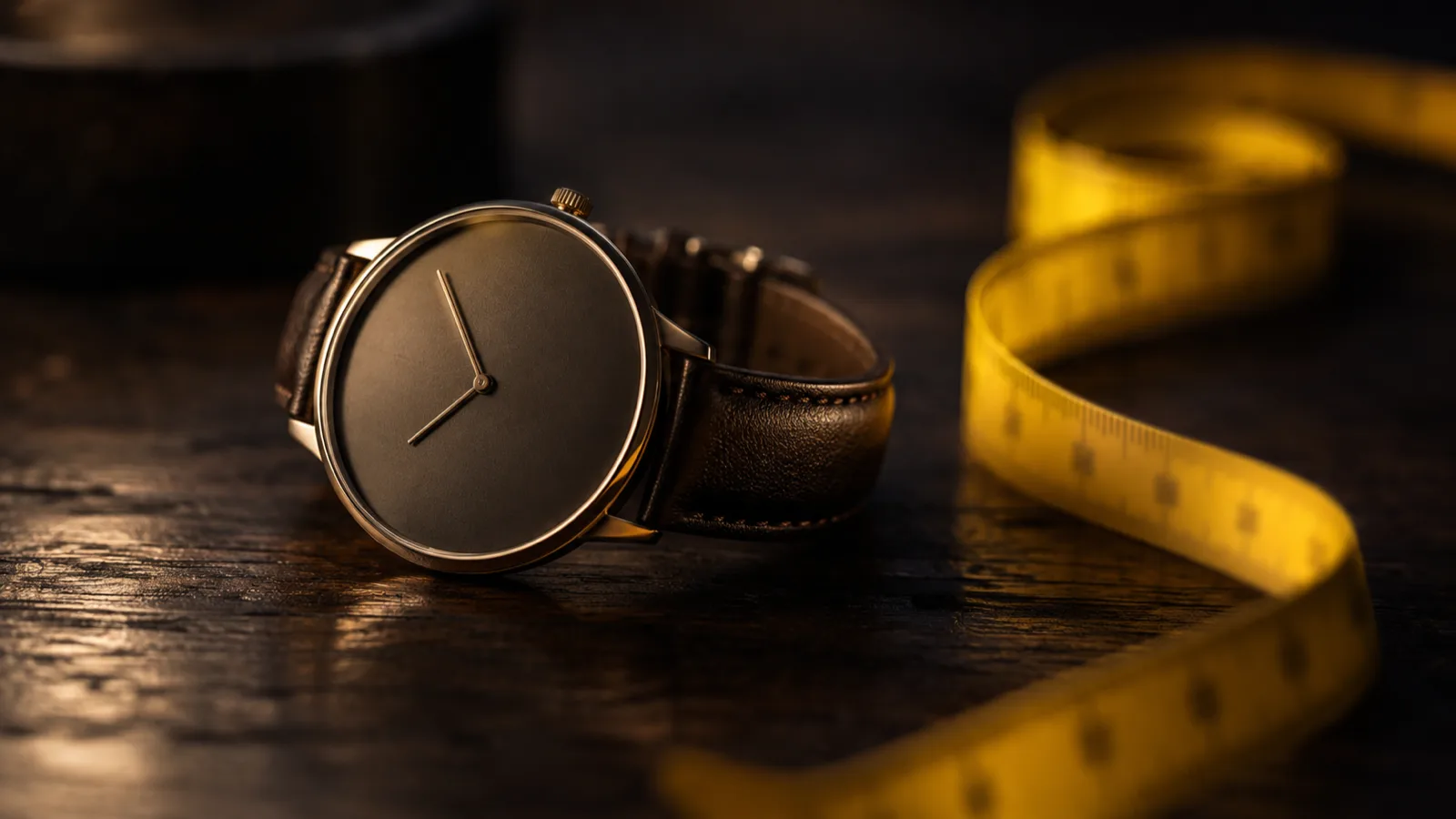
To measure wrist size, wrap a soft tailor’s tape around your bare wrist next to the wrist bone, where a watch or bracelet will sit, and read the number where the tape overlaps its zero end. Keep the tape flat and snug without pinching the skin. That number is your wrist circumference. For a bracelet you add about 1/2 to 1 inch (1.3 to 2.5 cm) for movement, and for a watch you compare the number to the strap maker’s size range.
What you need
- A soft tape measure. A cloth or vinyl sewing tape wraps around the wrist and gives a direct reading. A steel tape measure is too stiff to follow the curve.
- Or a strip of paper and a ruler. A strip about 1/2 in (1 cm) wide and 10 in (25 cm) long works well. Paper does not stretch, which makes it more reliable than string.
- A pen to mark the overlap and write the result down in both inches and centimeters. Many watch and jewelry brands list sizes in millimeters or centimeters, so having both saves converting later.
The same soft tape and the same snug fit apply when you measure hat size, where the tape goes around the head.
If you need a refresher on reading the small marks, see tape measure markings. Most sewing tapes show inches on one side and centimeters on the other.
Where to measure and how tight
Measure the wrist you will wear the piece on. The two wrists often differ slightly, so a measurement from the other arm can be off by a small amount.
- Hold your arm relaxed. Turn the palm up and keep the hand open. A clenched fist or a bent wrist tightens the tendons and changes the reading.
- Find the wrist bone. This is the bump on the outside of the wrist, on the little-finger side. A watch usually sits right next to it, on the forearm side. Bracelets sit at about the same spot and slide down over the bone when you move.
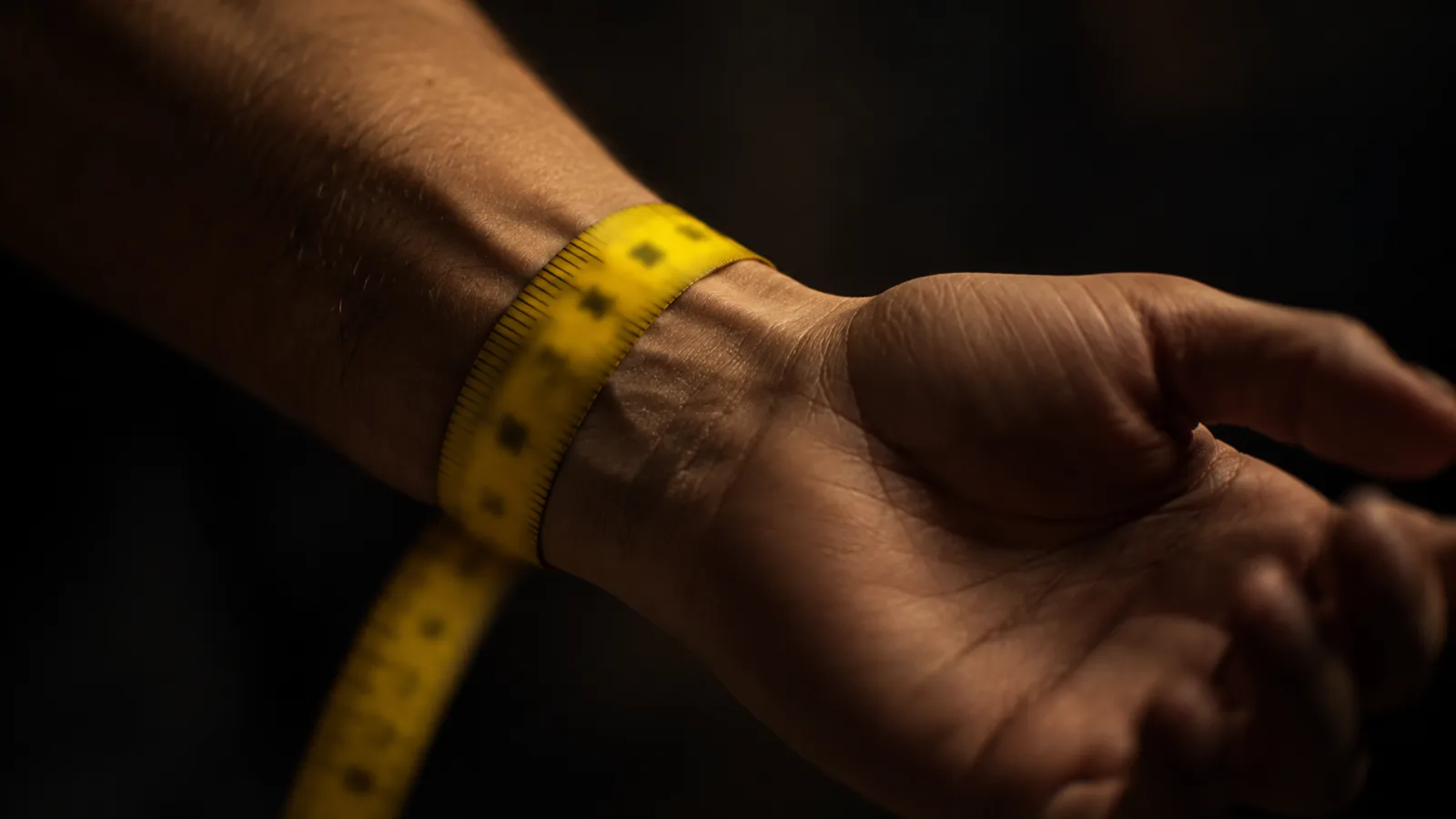
- Wrap the tape once around. Keep it flat against the skin, level all the way around, with no twist on the underside.
- Pull it snug. The tape should touch the skin everywhere without pressing a dent into it. If it leaves a mark, it is too tight.
- Read the overlap. Note the number where the tape meets its own zero end, to the nearest 1/8 in or the nearest millimeter.
Measure two or three times and use the number that repeats. Wrists swell slightly in heat and after exercise, so a mid-day reading at room temperature is a fair middle value.
The paper strip method
If there is no soft tape in the house, a strip of paper does the same job.
- Cut a strip of paper about 1/2 in wide.
- Wrap it around the wrist at the same spot, snug and flat.
- Mark the point where the end overlaps with a pen.
- Lay the strip flat on a ruler or a steel tape and measure from the end to the mark.
The length up to the mark is your wrist circumference. String works the same way, but it can stretch or dig into the skin, so pull it gently and measure it straight. For more tricks like this, see how to measure without a tape measure, and for reading the ruler itself, how to read a ruler.
Sizing a bracelet from your wrist measurement
A bracelet needs room to move, so its length is longer than your wrist. Jewelers do not agree on one exact allowance. USA Jewels suggests adding 1/2 in (1.3 cm) for a snug fit, 3/4 in (about 2 cm) for a standard fit and 1 in (2.5 cm) for a loose fit. Other retailers suggest as little as 1/4 in for snug. Thick chains and chunky beads take up more room inside the loop, so they usually need the larger allowance.
The table below applies those three allowances to common wrist sizes. The numbers are computed, so use them as a starting point and check the brand’s own chart.
| Wrist | Snug (+1/2 in) | Standard (+3/4 in) | Loose (+1 in) |
|---|---|---|---|
| 5 1/2 in (14.0 cm) | 6 in (15.2 cm) | 6 1/4 in (15.9 cm) | 6 1/2 in (16.5 cm) |
| 6 in (15.2 cm) | 6 1/2 in (16.5 cm) | 6 3/4 in (17.1 cm) | 7 in (17.8 cm) |
| 6 1/2 in (16.5 cm) | 7 in (17.8 cm) | 7 1/4 in (18.4 cm) | 7 1/2 in (19.1 cm) |
| 7 in (17.8 cm) | 7 1/2 in (19.1 cm) | 7 3/4 in (19.7 cm) | 8 in (20.3 cm) |
| 7 1/2 in (19.1 cm) | 8 in (20.3 cm) | 8 1/4 in (21.0 cm) | 8 1/2 in (21.6 cm) |
| 8 in (20.3 cm) | 8 1/2 in (21.6 cm) | 8 3/4 in (22.2 cm) | 9 in (22.9 cm) |
Size labels such as small, medium and large mean different lengths at different brands. Go by the length in inches or centimeters. If you land between two lengths, most jewelers suggest the longer one.
Bangles and solid cuffs are different. They have to pass over the hand, so they are sized by the widest part of the hand across the knuckles, with the thumb tucked in. A wrist measurement alone will give you a bangle that does not go on.
Sizing a watch strap or bracelet
Watches fit closer than jewelry bracelets because the case should sit flat on top of the wrist without sliding around.
- Metal watch bracelets. Retailers such as WatchGecko and Helveti suggest adding about 0.5 to 1 cm (roughly 1/4 to 3/8 in) to your wrist measurement. A good check when you try it on is that one finger slides under the bracelet with a little effort.
- Leather straps. WatchGecko suggests a strap about 2 cm (3/4 in) longer than your wrist, because leather starts stiff and softens with wear.
- Two-piece straps. These are often listed as two lengths, such as 120/75 mm for the long piece and the buckle piece, and many makers publish the wrist range each length fits. Match your wrist measurement to that range instead of adding your own allowance.
- Nylon pass-through straps come in fixed lengths with plenty of spare tail. Military-style nylon straps tend to run shorter, so check the listed length if your wrist is on the large side.
A metal bracelet that is slightly long can be adjusted with half links or the micro-adjust holes in the clasp. One that is too short needs an extra link from the maker, which is harder to find for older models.
Common mistakes
- Measuring over a sleeve or an old watch. Measure bare skin.
- Pulling the tape tight. A tape that dents the skin gives a reading that is too small, and the bracelet will pinch.
- Measuring at the wrong spot. The wrist is wider over the bone itself and narrower right beside it. Measure where the piece will actually rest.
- Adding allowance twice. If a watch or bracelet chart already lists wrist sizes, compare your bare wrist number to it directly.
- Reading the wrong scale. Sewing tapes often have inches on one face and centimeters on the other. Write down which one you read.
Sources
- How To Measure Your Wrist Size, WatchGecko: wrap the tape or a paper strip just below the wrist bone, snug but not too tight; add about 1 cm for a metal bracelet and choose a leather strap about 2 cm larger; nylon military straps run shorter.
- How to measure your wrist, Helveti: add about 0.5 to 1 cm for a metal watch bracelet, and check the fit with one finger under the bracelet.
- How to Measure Your Wrist for the Right Bracelet Size, USA Jewels: measure bare skin where the bracelet will sit, add 1/2 in for snug, 3/4 in for standard and 1 in for loose, size up between sizes, and measure bangles across the knuckles.