How to measure hips
How to measure hips: wrap a soft tape around the fullest part of your hips and buttocks, level with the floor. Where that is, posture, mistakes and size chart.
October 27, 2026
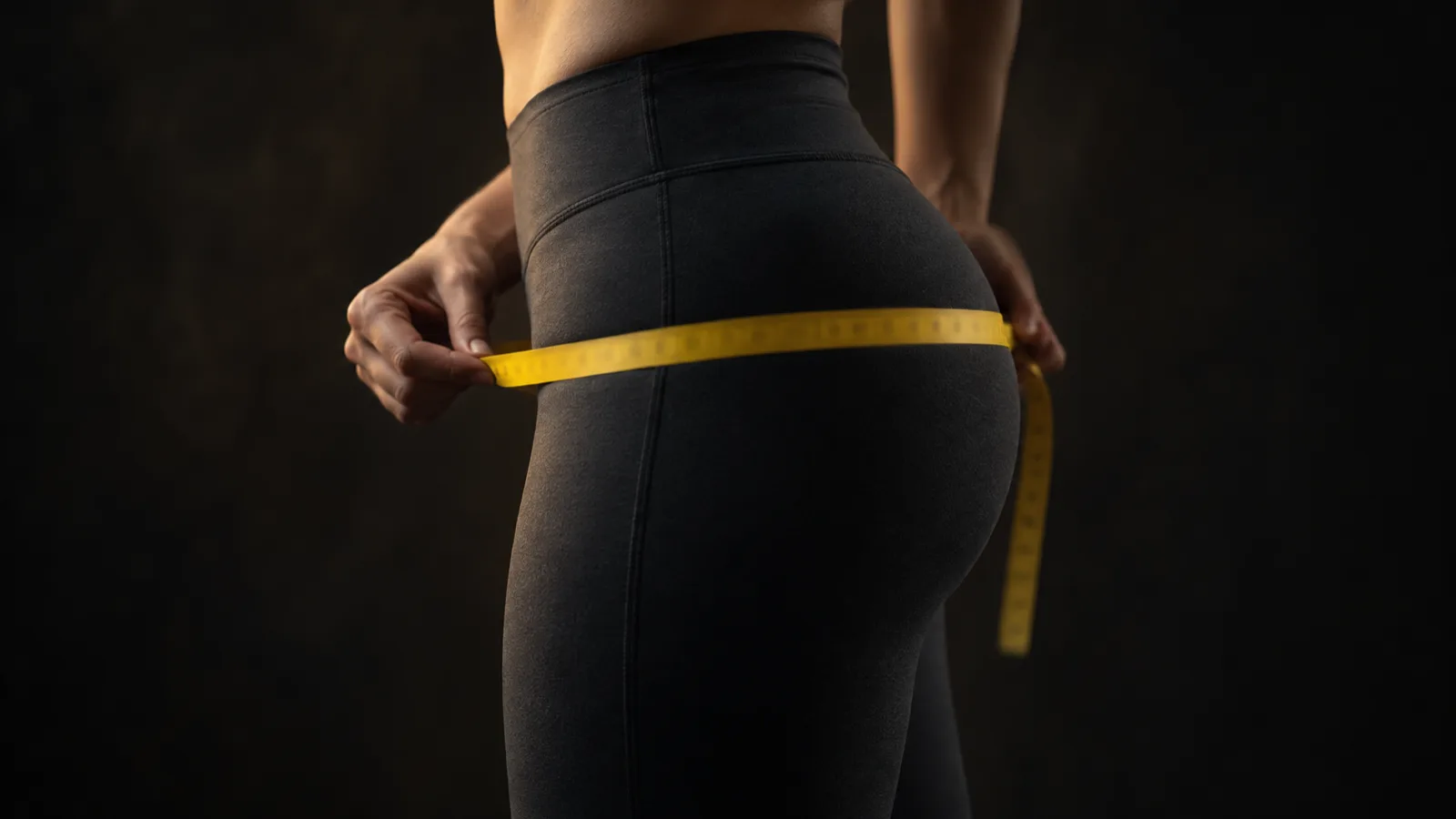
To measure your hips, stand straight with your feet together and wrap a soft tape measure around the fullest part of your hips and buttocks, keeping the tape level with the floor. Pull it snug so it lies flat without squeezing, then read the number where the end of the tape meets the rest of it. For most people the fullest part sits about 7 to 9 inches (18 to 23 cm) below the natural waist.
What you need
- A soft tape measure. A cloth or fiberglass sewing tape wraps around the body. A steel tape measure is too stiff and will give a reading that is too large.
- A mirror or a helper. The hard part of this measurement is keeping the tape level across your back, and you cannot see that without help.
- Thin clothing. Measure over leggings, tights or underwear. Jeans, back pockets, belts and phones in pockets all add to the number.
No soft tape at home? Wrap a piece of string or a phone charger cable around your hips, pinch the point where it meets, then lay it flat along a steel tape or ruler. The guide on how to measure without a tape measure has more ways to do this.
Where to measure your hips
The hip measurement goes around the widest part of your lower body, which is usually across the most prominent point of the buttocks. Look at yourself from the side in a mirror. The place where your body sticks out furthest at the back is where the tape belongs.
Many people put the tape on their hip bones, the bony points you can feel at the front and sides just below the waist. That spot is higher and almost always smaller. Sewing patterns sometimes ask for it separately as a high hip measurement, taken a few inches below the waist, but it is a different number from your hip size.
The 7 to 9 inch rule is a starting point, since height and body shape move the fullest part up or down. To find it, start at the top of the buttocks, then slide the tape down about an inch at a time, keeping it level, and note each reading. The largest number is your hip measurement.
How to measure your hips step by step
- Stand straight. Put your feet close together, spread your weight evenly on both feet and let your arms hang at your sides. Feet apart or one hip pushed out changes the shape you are measuring.
- Find the fullest part. Turn sideways to the mirror and locate the widest point at the back.
- Wrap the tape. Hold the zero end at the front of one hip and pass the tape around your back and across the front until it overlaps the zero end.
- Level it. Check in the mirror that the tape sits at the same height at the front, sides and back. If you are alone, turn slowly and look at each side.
- Set the tension. The tape should lie flat against your body all the way around, with no gaps and no dent in the skin or fabric.
- Read it. Read the mark where the tape crosses the zero end, to the nearest 1/4 inch or half centimeter. If the small marks are confusing, see how to read a tape measure.
- Repeat. Take the measurement twice. If the two readings are within about 1/2 inch (1 cm) of each other, use the average. If they differ by more, measure both again.
Common mistakes
- The tape dips at the back. This is the most common error. A tape that slopes down over the buttocks travels a longer path and reads too large.
- Measuring at the hip bones. You get the high hip figure, which is smaller than your real hip size.
- Pulling too tight. A tape that digs in makes the number smaller than the clothes will need.
- Measuring over bulky clothes. Jeans with pockets, a sweater tucked in or a phone in a back pocket all add width.
- Looking down at the tape. Bending forward shifts your posture. Use the mirror and keep your head level.
Using your hip measurement for clothes
Pattern companies and clothing brands use the hip measurement to size pants, skirts and fitted dresses. For pants and skirts that are fitted through the hips, the hip number usually decides the size, even if your waist would put you in a different one.
Size charts are not shared between brands. A size 8 at one company can have a different hip measurement from a size 8 at another, so always compare your number to the chart for the brand you are buying. The table below is one example, taken from the women’s size guide at Stetson. The centimeter column is converted from its inches.
| Size | Numeric size | Hip (in) | Hip (cm) |
|---|---|---|---|
| XS | 0 | 34.5 | 87.6 |
| XS | 2 | 35.5 | 90.2 |
| S | 4 | 36.5 | 92.7 |
| S | 6 | 37.5 | 95.3 |
| M | 8 | 38.5 | 97.8 |
| M | 10 | 39.5 | 100.3 |
| L | 12 | 41 | 104.1 |
| L | 14 | 42.5 | 108.0 |
| XL | 16 | 44 | 111.8 |
| XL | 18 | 45.5 | 115.6 |
These are body measurements, which is what you just took. A garment’s own measurements are larger, because the maker adds room to move. If your hips fall between two sizes, stretch fabrics usually allow the smaller size, while woven fabrics without stretch usually need the larger one.
Waist-to-hip ratio
Doctors and researchers sometimes use the waist-to-hip ratio, which compares the two measurements. The hip part uses the same method described above. The World Health Organization’s 2008 expert consultation on waist circumference and waist-hip ratio describes the hip measurement as taken around the widest portion of the buttocks with the tape parallel to the floor. The WHO method measures the waist midway between the lowest rib and the top of the hip bone, at the end of a normal breath out.
To calculate it, divide your waist by your hip, using the same unit for both. A 30 inch waist and a 40 inch hip give 30 ÷ 40 = 0.75. The WHO report uses a ratio above 0.90 for men and above 0.85 for women as a cut-off for abdominal obesity, which it links with a higher risk of metabolic conditions. The ratio is one screening measure among several. It does not describe an individual’s health on its own, and a doctor can put the number in context.
Hip measurements in inches and centimeters
One inch is exactly 2.54 cm. Use this table to switch between the two when a size chart uses the other unit.
| Inches | Centimeters |
|---|---|
| 32 | 81.3 |
| 34 | 86.4 |
| 36 | 91.4 |
| 38 | 96.5 |
| 40 | 101.6 |
| 42 | 106.7 |
| 44 | 111.8 |
| 46 | 116.8 |
| 48 | 121.9 |
| 50 | 127.0 |
Many soft tapes have centimeters on the back, so you can also flip the tape over. The guide to tape measure markings explains both scales.
Sources
- Waist–hip ratio, Wikipedia: quotes the WHO 2008 expert consultation, with hip circumference measured around the widest portion of the buttocks with the tape parallel to the floor, and cut-offs above 0.90 for men and 0.85 for women.
- Waist-to-Hip Ratio, MDCalc: hip around the widest portion of the buttocks, waist at the midpoint between the last rib and the top of the iliac crest, both taken standing at the end of a normal breath out.
- Measure Up: Taking Measurements for Clothes, National Sewing Circle: the fullest part of the hips is usually about 7 to 9 inches below the natural waist.
- Size Guide, Stetson: women’s size chart with hip measurements in inches from size 0 to 24W.