How to measure a bike frame
How to measure a bike frame: seat tube center-to-top vs center-to-center, road vs mountain sizing, inseam rule of thumb, stack and reach, and a height chart.
November 20, 2026
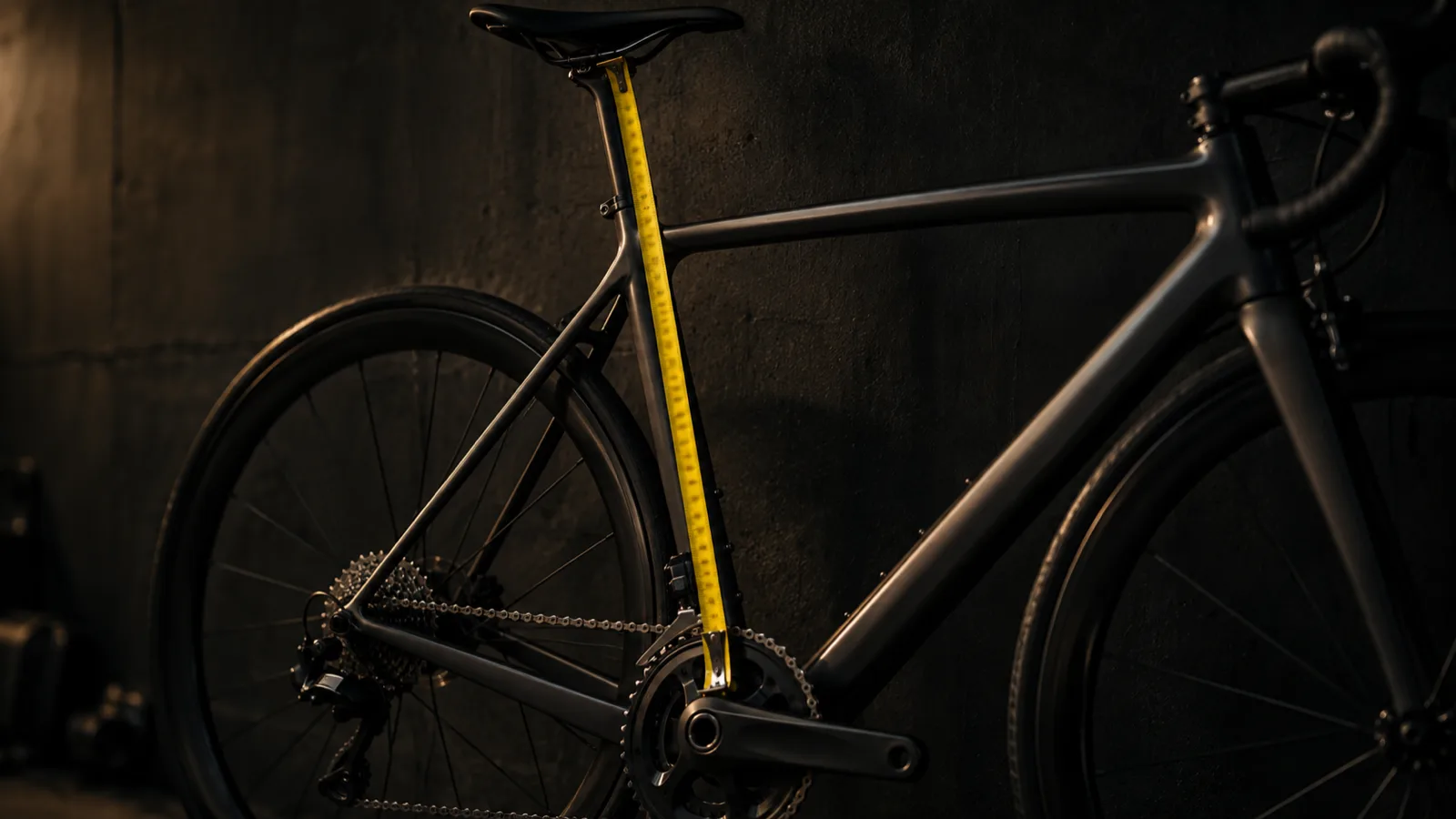
To measure a bike frame, measure the seat tube from the center of the bottom bracket (the axle the cranks turn on) straight up along the tube to its top. That length is the frame size most brands use, given in centimeters for road bikes and in inches for many mountain and hybrid bikes. Brands end the measurement at different points, so compare your number with the brand’s geometry chart before you buy or sell.
Where frame size is measured
Frame size refers to the seat tube, the tube that runs from the crank area up to the saddle. The bottom end is always the center of the bottom bracket. The top end is where brands differ.
- Center-to-top (c-t) runs to the top of the seat tube, where the seatpost clamp sits. Some brands stop at the top of the top tube instead.
- Center-to-center (c-c) runs to the point where the center line of the top tube meets the seat tube.
On the same frame, c-t always reads larger than c-c, by at least half the top tube’s diameter plus however far the seat tube extends above it. Sloping top tubes add another variation, because some brands quote a virtual size measured to where the seat tube would end if the top tube were level. Sheldon Brown’s bicycle glossary notes that one frame can carry several different size numbers depending on the method, which is why a used 56 from one brand may not match a 56 from another.
How to measure the seat tube step by step
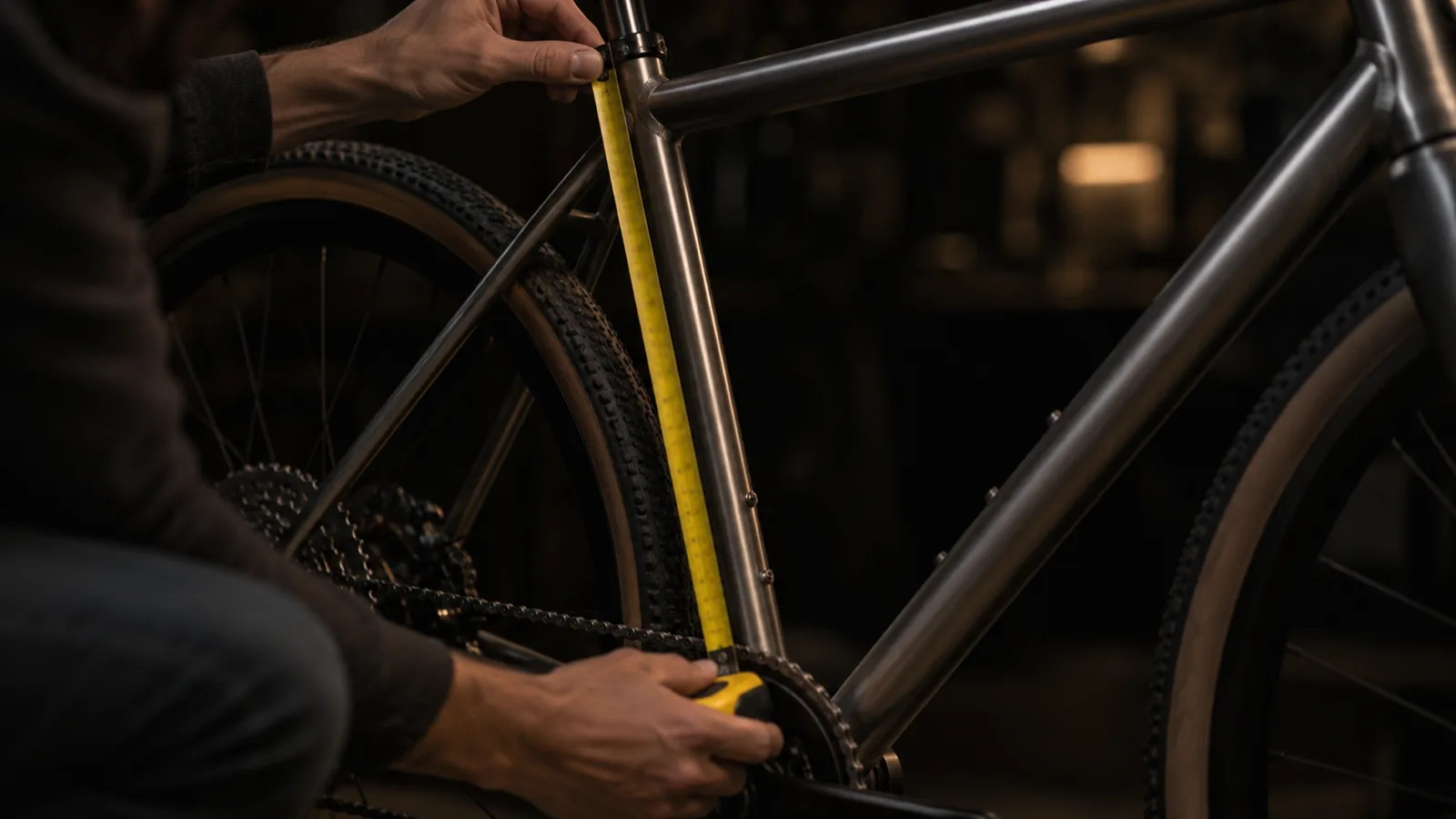
- Stand the bike upright on level ground and lean it against a wall, or have someone hold it. Both wheels on the floor.
- Find the bottom bracket center. It is the center of the crank axle, usually marked by the crank bolt or the middle of the crank arm’s mounting.
- Hold the tape’s zero there. A helper makes this easier. A steel tape with a stiff blade works well; see how to read a tape measure if the small marks give you trouble.
- Run the tape along the seat tube. Keep it parallel to the tube, not vertical. A seat tube leans back at an angle, and a vertical reading comes out short.
- Read at the top. For c-t, read at the top edge of the seat tube where the clamp sits. For c-c, read at the middle of the top tube where it joins.
- Write down the method with the number, for example 54 cm c-t. Read both cm and inches if your tape has both; tape measure markings explains the scales.
Leave the seatpost out of it. The post slides up and down and has nothing to do with frame size.
Road vs mountain bike sizing
Road bikes have traditionally been sized in centimeters, from around 44 cm for small riders to 60 cm and up for tall ones. Many brands now label road frames XS to XL instead, and a numbered size is not always the exact length of the tube.
Mountain bikes are usually sold as S, M, L and XL, sometimes with an inch figure such as 15, 17 or 19 in. Modern trail bikes have short seat tubes and long seatposts, so the seat tube says less about fit than it does on a road bike. Trek’s mountain bike sizing guide points riders to reach and effective top tube as the more useful numbers when comparing brands.
Hybrid and city bikes use either system, depending on the brand.
Do not confuse frame size with wheel size. A 29er has 29 in wheels, and that figure says nothing about how big the frame is.
Frame size from your inseam
Inseam, the distance from the floor to your crotch, predicts frame size better than height because two people of the same height can have very different leg lengths.
To measure it, stand barefoot with your back against a wall and your feet about 6 to 8 in (15 to 20 cm) apart. Press a hardback book up between your legs, spine up, as firmly as a saddle would sit. Measure from the top of the book to the floor.
A common rule of thumb multiplies inseam in centimeters by a factor to estimate frame size. One widely used calculator uses 0.665 for a road frame in centimeters and 0.226 for a mountain bike frame in inches.
| Inseam (in) | Inseam (cm) | Road frame, × 0.665 (cm) | Mountain frame, × 0.226 (in) |
|---|---|---|---|
| 28 | 71.1 | 47.3 | 16.1 |
| 30 | 76.2 | 50.7 | 17.2 |
| 32 | 81.3 | 54.1 | 18.4 |
| 34 | 86.4 | 57.4 | 19.5 |
| 36 | 91.4 | 60.8 | 20.7 |
Treat the result as a starting point. Then check standover: straddling the top tube with both feet flat on the floor, BikeRadar recommends at least 1 cm of clearance at the crotch on a road bike. Mountain bikes are normally given more room than that.
Frame size by rider height
Height charts are the quickest guide, but they are approximate and every brand publishes its own. This table follows BikeRadar’s general charts; if your height and inseam point to different sizes, trust the inseam and the brand’s chart.
| Rider height | Height (cm) | Road frame (cm) | Mountain bike |
|---|---|---|---|
| 4 ft 8 in – 5 ft 1 in | 143–155 | 44 | XS or smaller |
| 5 ft 1 in – 5 ft 4 in | 155–163 | 48 | XS (13–14 in) |
| 5 ft 4 in – 5 ft 7 in | 163–170 | 51 | S (14–16 in) |
| 5 ft 7 in – 5 ft 10 in | 170–178 | 54 | M (16–18 in) |
| 5 ft 10 in – 6 ft | 178–183 | 56 | L (18–20 in) |
| 6 ft – 6 ft 3 in | 183–191 | 58 | L or XL |
| 6 ft 3 in – 6 ft 5 in | 191–196 | 60 | XL (20–22 in) |
Measure your height barefoot against a wall. If no one is around to help, a height measurement app on your iPhone gives a close figure; confirm it with a tape if you sit on the line between two sizes.
Stack and reach
Because seat tube numbers vary so much, most brands now publish stack and reach in their geometry charts.
- Stack is the vertical distance from the center of the bottom bracket to the top center of the head tube.
- Reach is the horizontal distance between the same two points, measured from a vertical line through the bottom bracket to the center of the head tube.
Neither depends on where a brand chooses to end its seat tube measurement, so they let you compare frames across brands directly. A higher stack puts the handlebars higher for a more upright position. A longer reach stretches you out; Trek notes it feels more stable at speed and roomier for riders with a long torso or long arms, while a shorter reach is more nimble. If you already have a bike that fits, look up its stack and reach and use them as your baseline.
Sources
- Bicycle Glossary E–F (Frame Size), Sheldon Brown: frame size is the seat tube measured from the center of the bottom bracket, brands end the measurement at different points, and one frame can be described by several different size numbers.
- Bike size guide and Road bike sizing, BikeRadar: road frame sizes in cm and mountain bike sizes by rider height, at least 1 cm of standover clearance, and stack and reach figures quoted by most bike makers.
- Bike Size Calculator, calculate.co.nz: inseam × 0.665 for a road frame in cm, inseam (cm) × 0.226 for a mountain bike frame in inches, and the book-against-the-wall inseam method.
- What Size Mountain Bike Do I Need?, Trek: reach and effective top tube as the key comparison figures, and how longer and shorter reach feel.